
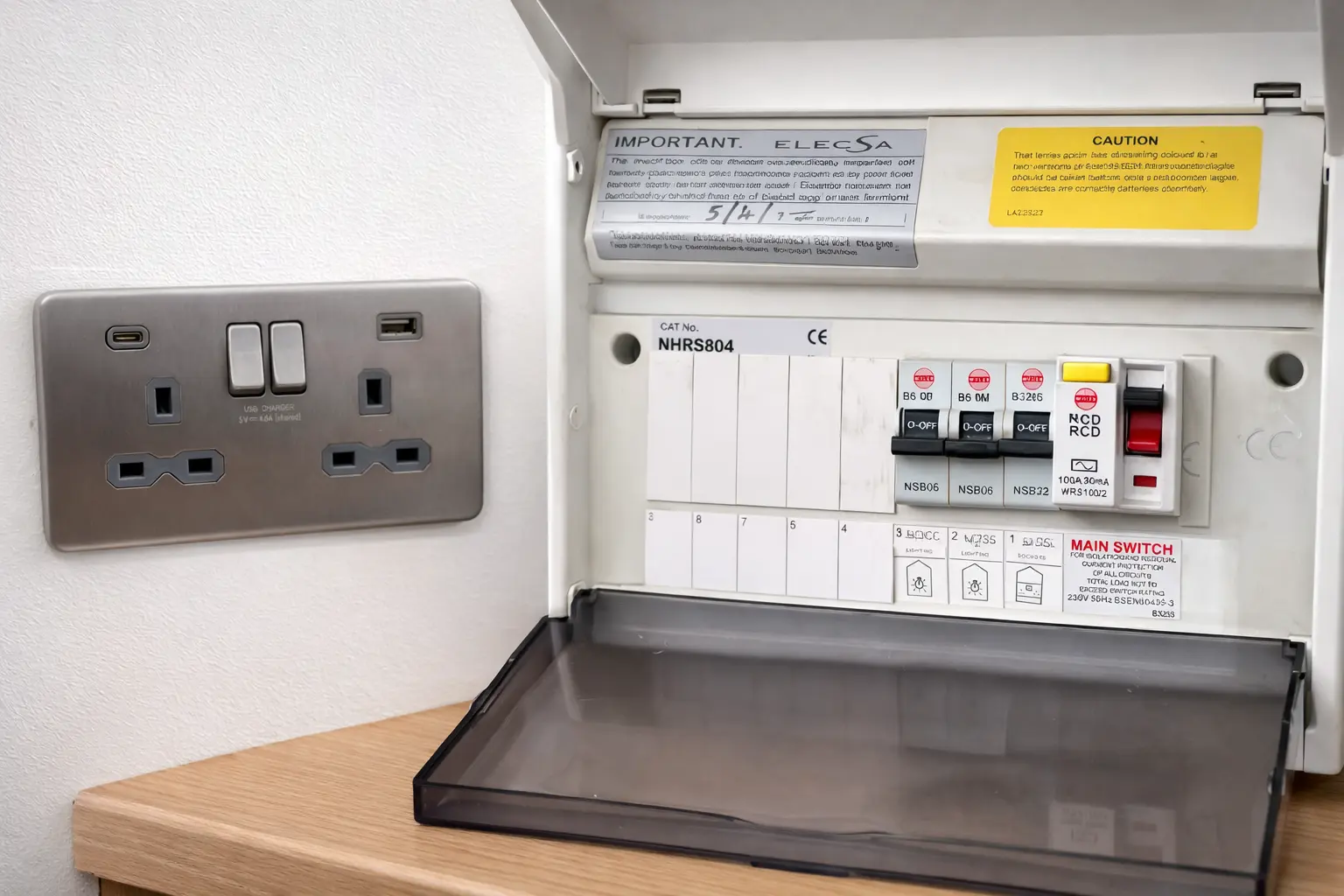
If your fuse box trips with nothing plugged in, it can feel confusing and a bit worrying. From experience, this is one of those faults that catches people off guard because you assume “nothing is using power, so what’s the problem?” — but that’s not how electrics work in most UK homes.
On most jobs I attend, this issue usually points to a hidden fault somewhere in the circuit rather than anything obvious like a kettle or appliance.
Quick Answer
- Usually caused by a faulty circuit or wiring issue
- Often linked to an RCD detecting leakage to earth
- Could be a damaged cable, moisture, or faulty fixed appliance
- Sometimes caused by lighting circuits or outdoor wiring
- Needs proper testing if it keeps happening
Signs of the Problem
If your fuse box trips with nothing plugged in, you’ll usually notice:
- The RCD trips randomly
- It trips even when sockets are empty
- Lights or circuits may go off suddenly
- It may happen more in wet weather
- Reset works temporarily, then trips again
From experience, if it’s happening randomly without load, it’s almost never “nothing” — there’s always something behind it.
Understanding (RCD / MCB)
Most modern UK consumer units use two key safety devices:
- RCD (Residual Current Device) – protects against electric shock
- MCB (Miniature Circuit Breaker) – protects against overloads
If your fuse box trips with nothing plugged in, it’s usually the RCD, not the MCB.
Why?
Because the RCD detects leakage current — not overload. So even a tiny fault can trip it.
You can read more about how RCD protection works on Electrical Safety First
Causes (Real-World Explanation)
From experience, these are the most common causes I see:
1. Hidden Cable Damage
Wires inside walls can get damaged over time:
- Nails or screws through cables
- Rodents (rare, but happens)
- Old insulation breakdown
2. Moisture in Outdoor Circuits
Very common in UK homes.
- Garden lights
- Outdoor sockets
- Shed wiring
Rain gets in → causes leakage → RCD trips.
3. Faulty Fixed Appliances
Even if nothing is “plugged in,” some things are still connected:
- Boiler
- Cooker
- Extractor fan
- Immersion heater
These are wired directly, so people forget about them.
4. Lighting Circuit Fault
On most jobs I attend, lighting circuits are a big culprit.
- Faulty light fittings
- Damp loft connections
- Downlights with insulation contact
5. Neutral-Earth Fault
This is a classic electrician fault-finding job.
- Neutral touching earth somewhere
- Causes imbalance → trips RCD instantly
What I’d Do First (Personal Method)
If I walked into your house with this issue, here’s exactly what I’d do:
- Reset the fuse box
- Turn off all MCBs
- Turn them back on one by one
- Identify which circuit trips the RCD
This quickly narrows down the problem.
From experience, this saves a lot of guessing.
Step-by-Step Fix
Only do basic checks — anything more, call an electrician.
Step 1: Reset Everything
- Turn all breakers off
- Turn RCD back on
- Switch circuits on one at a time
Step 2: Identify the Faulty Circuit
When it trips → that’s your problem circuit.
Step 3: Check That Circuit
Depending on what it is:
Sockets circuit
- Check for damaged sockets
- Look for burnt smells
Lighting circuit
- Remove bulbs one by one
- Check fittings
Outdoor circuit
- Inspect for water ingress
Step 4: Isolate Fixed Appliances
Turn off:
- Boiler spur
- Cooker switch
- Immersion heater
Then test again.
Safety Warning
Electric faults are not something to guess with.
- Never keep resetting a tripping RCD repeatedly
- Don’t open sockets unless you know what you’re doing
- Faults like this can indicate shock risk or fire risk
When to Call an Electrician
Call a qualified electrician if:
- You can’t identify the circuit
- It trips immediately every time
- It happens during rain
- You suspect wiring damage
You can find registered electricians via NICEIC or NAPIT
What People Get Wrong
From experience, these are common mistakes:
- “Nothing is plugged in so it must be the fuse box”
- Replacing the consumer unit without testing
- Ignoring outdoor wiring
- Blaming the RCD (it’s usually doing its job)
Real Electrician Insight
On most jobs I attend, when a fuse box trips with nothing plugged in, it ends up being:
- A damp outside light
- A loft junction box full of moisture
- Or a damaged cable someone drilled into years ago
It’s rarely random — it just feels that way.
Frequently Asked Questions
Why does my fuse box trip randomly at night?
Usually moisture or temperature changes affecting wiring or outdoor circuits.
Can a fuse box trip with no load?
Yes — because RCDs trip on leakage, not load.
Is this dangerous?
It can be. It often indicates a fault that could cause shock.
Can I fix this myself?
Only basic isolation. Proper fault finding needs testing equipment.
Could it be the fuse box itself?
Very rare. 9 times out of 10, it’s a circuit issue.
Why does it trip more when it rains?
Water causes current leakage — very common with outdoor electrics.
Final Thoughts
If your fuse box trips with nothing plugged in, don’t ignore it. From experience, these faults don’t fix themselves — they usually get worse over time.
Start with simple isolation checks, but if you’re unsure, get it tested properly. It’s always cheaper (and safer) to fix early than deal with bigger issues later.
Related Posts
- Fuse box trips when kettle is on
- RCD keeps tripping
- Consumer unit keeps tripping
- Why does my electricity keep tripping