
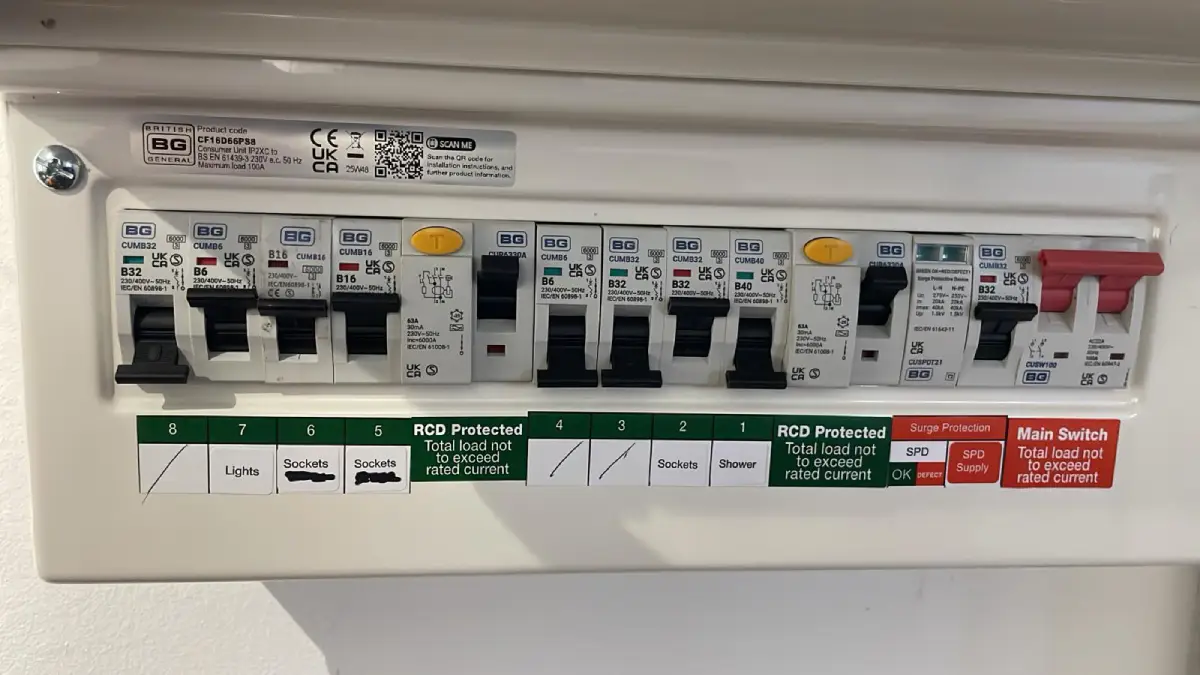
If your fuse box keeps tripping, it is usually caused by a faulty appliance, an overloaded circuit, or an electrical fault such as earth leakage. In most UK homes, this is a common issue and often fairly easy to diagnose. However, if your fuse box keeps tripping repeatedly, it should never be ignored, because it is a clear sign that something in your electrical system is not working correctly.
Your fuse box, also known as a consumer unit, is designed to protect you. When your fuse box keeps tripping, it is normally doing its job by shutting off power to prevent electric shock, overheating, or even fire.
Table of Contents
Quick Answer
In short: your fuse box trips because:
- A faulty appliance is leaking electricity
- Too many devices are overloading a circuit
- Moisture or water is causing leakage
- A cable or circuit has developed a fault
Signs Your Fuse Box Is Tripping
You may notice:
- Power suddenly cuts out
- One switch repeatedly tripping
- The issue happening when using certain appliances
- Power returning after reset, then tripping again
- Only sockets or lights losing power
If your fuse box keeps tripping, these are usually the first warning signs that help you narrow down the cause.
Understanding Your Fuse Box (Consumer Unit)
Most UK consumer units include:
MCB (Miniature Circuit Breaker)
Protects against overload and short circuits
RCD (Residual Current Device)
Protects against electric shock by detecting leakage
RCBO
Combines both protections
If the RCD is tripping, it’s usually leakage
If the MCB is tripping, it’s usually overload
Understanding this is important, because when your fuse box keeps tripping, knowing which device has tripped helps you find the fault much faster.
Why Your Fuse Box Keeps Tripping
If your fuse box keeps tripping, these are the most common reasons in UK homes.
1. Faulty Appliance
This is the most common cause. Appliances such as kettles, washing machines, heaters, toasters, and dishwashers can develop internal faults over time and start leaking current.
If your fuse box keeps tripping when you switch on one particular appliance, that appliance is the first thing to check.
2. Overloaded Circuit
Too many high-power devices on one circuit can overload it and cause the breaker to trip.
For example, running a kettle, microwave, and toaster together on the same kitchen circuit can easily create problems in some homes.
3. Earth Leakage
Earth leakage is often caused by faulty appliances, damaged cables, or moisture. This usually trips the RCD rather than the MCB.
4. Moisture Issues
Outdoor sockets, garden lighting, and damp areas can cause leakage and repeated tripping. Rainwater and condensation are common causes, especially on external circuits.
5. Wiring Faults
Loose connections or damaged wiring can cause repeated tripping and require professional testing.
How to Fix a Tripping Fuse Box (Step-by-Step)
Step 1: Turn Off and Unplug Everything
Disconnect all appliances to remove possible fault sources.
Step 2: Reset the Fuse Box
Turn the tripped switch back on.
- If it stays on → continue
- If it trips immediately → likely wiring issue
Step 3: Plug Appliances Back One by One
Reconnect devices slowly.
When it trips again, you’ve found the faulty appliance
Step 4: Identify the Circuit
Turn circuits on one at a time to isolate the issue
Step 5: Check Outdoor Areas
Inspect outdoor sockets, lights, and damp areas
Safety Warning
Electricity is dangerous—always take precautions.
Do NOT attempt repairs if:
- You smell burning
- You see exposed wires
- The fuse box trips instantly
- You are unsure what you’re doing
When Should You Call an Electrician?
Call a professional if:
- The fuse box keeps tripping with nothing plugged in
- You cannot find the faulty appliance
- The issue keeps returning
- You suspect wiring damage
What Most People Get Wrong
Many people assume the fuse box is faulty.
In reality, the fuse box is doing its job—protecting you.
Replacing it will not fix the issue unless the root cause is identified.
Real Electrician Insight
From real experience, most tripping issues are caused by appliances like kettles and washing machines.
However, in some cases, the real issue is hidden wiring damage or moisture in outdoor fittings—so always diagnose properly before replacing anything.
Frequently Asked Questions
Why does my fuse box keep tripping randomly?
Usually due to a faulty appliance or moisture affecting a circuit.
Why does my RCD keep tripping but not the MCB?
This indicates electrical leakage.
Can a faulty appliance cause the fuse box to trip?
Yes, this is the most common cause.
Is it dangerous if my fuse box keeps tripping?
Yes, it indicates a fault—but the fuse box protects you.
How do I know if it’s wiring or an appliance?
Trips with everything unplugged → wiring
Trips with specific device → appliance
Can moisture cause fuse box tripping?
Yes, especially in outdoor or damp environments.
Final Thoughts
A fuse box that keeps tripping is a warning—not something to ignore.
In most cases, the issue is:
- A faulty appliance
- Or an overloaded circuit
By following a step-by-step approach, you can safely identify the problem and decide whether you need professional help.
Related Guides
- How to test an RCD safely
- What is the difference between MCB and RCBO
- Why sockets stop working in one room